

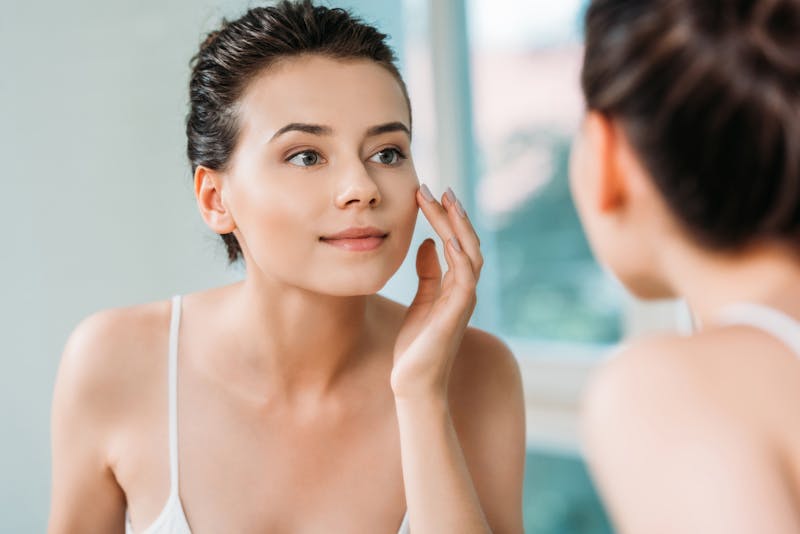
A cheek “lift” can mean very different things depending on what your face actually needs. In some patients, a light touch restores gentle mid-cheek support and softens early hollowing without adding bulk. In others, true rejuvenation requires structural volume to rebuild the cheek framework (and sometimes the jawline) so the entire face reads balanced again.
At Weber Facial Plastic Surgery, filler planning is approached as facial surgery without the scalpel: anatomy-first, proportion-driven, and intentionally restrained. Stephen Weber, MD, PhD, FACS, is a double board-certified facial plastic surgeon with an exclusive focus on the face and neck. He is also a National Physician Trainer for Allergan Medical Institute, teaching injection technique and safety to other clinicians.
In this blog, we’ll discuss which fillers are best for subtle cheek lifting, which are best for full facial contouring, and how we can help you decide which is best for you.
How to Achieve a Subtle Cheek Lift
This is the right category when you want:
- A soft mid-cheek refresh (not a dramatic cheekbone)
- Gentle support for early descent or hollowing
- An outcome that reads “healthy and rested,” not “filled”
Clinically, this often involves treating mild volume changes in the midface while maintaining smooth transitions. Softer or more flexible products can work well in this category, especially when the goal is support without heaviness.
When You Want Full Facial Contouring
If your goals are:
- More visible cheek definition (zygoma projection, higher cheekbone emphasis)
- Structural restoration in mature faces with deeper volume loss
- Contour support that often extends beyond the cheek into the chin/jawline for harmony
…then “volumetric” fillers and biostimulators can be used to rebuild the framework.
The science behind why certain materials provide firmer projection (and why some also stimulate collagen) is well described in the literature on biostimulatory fillers and tissue response, including calcium hydroxylapatite (CaHA) and poly-L-lactic acid (PLLA).
Subtle Cheek Lift: Sculptra for Gentle Support That Lifts Without Heaviness
When the goal is a quiet mid-cheek improvement—especially in early hollowing—Sculptra (PLLA) is often considered because it works gradually by stimulating collagen rather than “inflating” the area.
Keep the following in mind:
- PLLA creates a foundation of support over time
- That gradual change can be ideal for patients who want to look better without looking obviously treated
- Early midface hollowing, mild descent, and patients who prefer a slow, natural build rather than immediate volume
- PLLA has distinct technique requirements and is not a “quick sculpting gel,” so planning matters
Full Contouring: Volumetric HA Fillers to Build Cheekbones and Restore Structure
If you want higher cheekbones, zygoma definition, or a more noticeable structural refresh, you’re typically looking at denser hyaluronic acid (HA) fillers placed strategically—often deeper—so the cheek looks supported, not puffy.
Weber Facial Plastic Surgery offers the following:
- Juvéderm Voluma XC: FDA-indicated for deep injection for cheek augmentation to correct age-related midface volume deficit.
- Restylane Lyft: FDA-indicated for cheek augmentation and correction of age-related midface contour deficiencies (with deep placement).
Different HA fillers are engineered with varying elastic and cohesive properties, which influence how well they maintain their shape, projection, and support in deeper planes.
Calcium Hydroxylapatite for Projection: Radiesse Excels in Sharper Definition
When the goal is firm projection—especially for cheek and jaw definition—Radiesse (CaHA) is often discussed because it can provide immediate contouring, as well as biostimulatory effects.
CaHA has a reputation for firmness and definition, which can be helpful when building contours that need to read clearly visible in profile and three-quarter views. Additionally, CaHA has been associated with changes in collagen and the extracellular matrix that extend beyond the immediate gel effect.
However, CaHA is not dissolved the way HA fillers can be, so product selection and placement strategy must be meticulous and intentional.
Duration Differences
The product, depth, dose, metabolism, and the expression of the area influence longevity. But as a general planning framework:
- Subtle lifts often last ~9–12 months when achieved with softer, more flexible fillers placed to support rather than sculpt
- Full contouring often lasts ~12–18 months when using higher “support” products (often characterized by a higher elastic modulus/higher structural behavior) or biostimulatory approaches
Patient Selection: How Age and Anatomy Guide the “Best” Cheek Filler
Younger patients with mild descent or early hollowing often do best with:
- Subtle HA support (to refresh without changing facial identity), and/or
- Biostimulatory planning when the priority is gradual, quiet improvement rather than immediate projection
These patients typically don’t need aggressive cheekbone building. The risk in younger faces is adding volume where structure is already strong, creating heaviness instead of lift.
Mature faces with broader volume loss often benefit from:
- Structural contouring agents (denser HA, CaHA, or biostimulatory strategies)
- A plan that restores support across the midface—and sometimes the lower face—to keep proportions harmonious
In mature anatomy, under-treating the structure can lead to “chasing” lines rather than restoring the framework that gives the face a naturally supported appearance.
How Weber Facial Plastic Surgery Approaches Subtle Cheek Lift vs. Full Contouring
A subtle cheek lift and full facial contouring serve distinctly different aesthetic purposes, even though both utilize dermal fillers. A subtle cheek lift restores soft mid-cheek support, improving early hollowing and creating a refreshed appearance without adding visible volume. Full facial contouring focuses on rebuilding structure—enhancing cheekbone definition, supporting the zygoma, and reestablishing facial balance for a more youthful and well-supported appearance.
At Weber Facial Plastic Surgery, these decisions are guided by facial specialization and careful analysis rather than trends. Each treatment plan is individualized, with products selected for their specific properties and techniques tailored to your anatomy and natural features.
For patients deciding between subtle enhancement and more comprehensive contouring, a consultation enables us to assess facial movement, discuss desired changes, and design a plan that prioritizes natural results and long-term confidence. Schedule your consultation with Stephen Weber, MD, PhD, FACS, today.